Göttingen Researchers Honored for Study on the Specialization of Nerve Cells in the Visual Cortex
Dr. Stefan Pommer, Dr. Andreas Neef, and Prof. Dr. Jochen Staiger, along with other participating researchers, were honored with the Quarterly Publication Award (QPA) II/2026 from the Anatomical Society for their study, “Intrinsic neuronal diversity as a substrate for cortical area specialization in primate vision,” which was recently published in the prestigious journal Nature Communications.
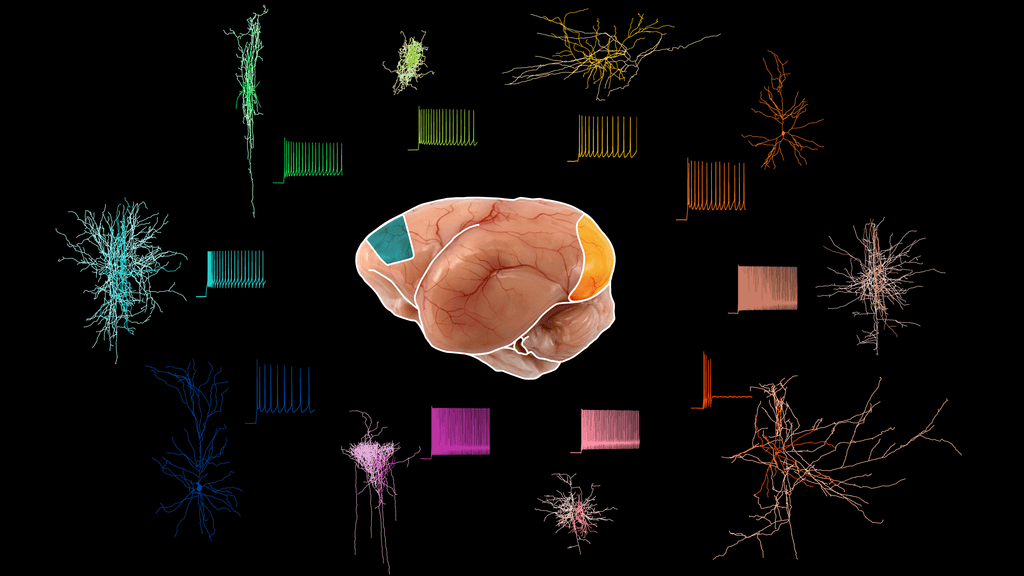
At the center of the image is the nearly lissencephalic brain of a common marmoset. The cortical areas under investigation are color-coded (turquoise: dorsolateral prefrontal cortex; orange: primary visual cortex). Surrounding the brain, characteristic types of excitatory and inhibitory neurons are depicted, illustrating their morphology and action potential firing patterns.
An international collaborative project investigated the cerebral cortex of common marmosets for areal specialization. Indeed, it was found that the cellular composition of the dorsolateral prefrontal cortex (responsible for working memory) differs from that of the primary visual cortex (responsible for analyzing "retinal images") in ways that could be advantageous for their respective functions, given that significant differences were observed in both structural and functional parameters.
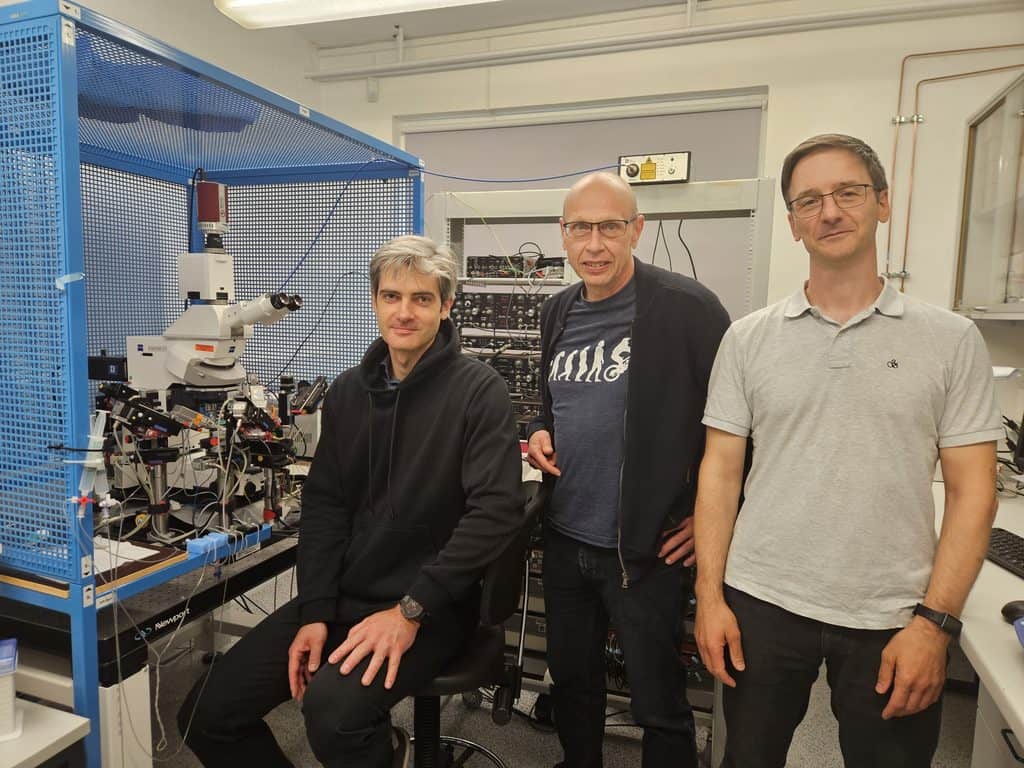
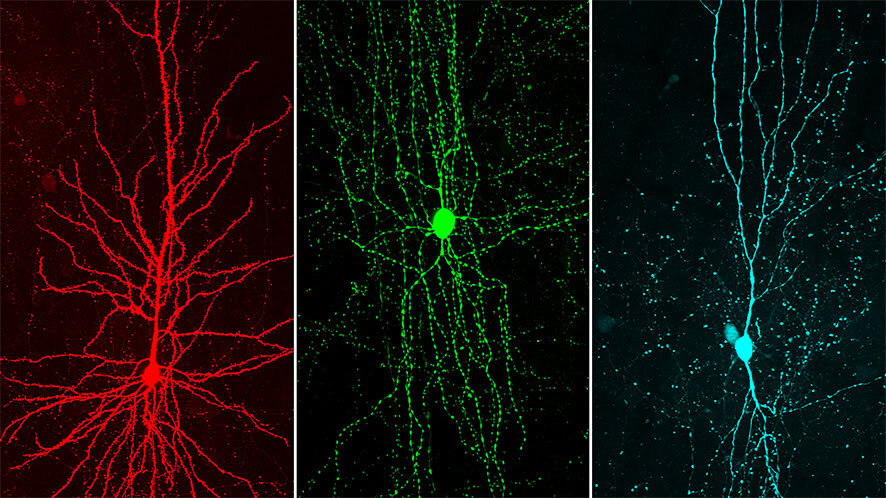
Dr. Stefan Pommer, research associate at the Institute of Neuroanatomy at the University Medical Center Göttingen (UMG); Prof. Dr. Jochen Staiger, Director of the Institute of Neuroanatomy at the UMG; and Dr. Andreas Neef, head of the Neurophysics Laboratory at the Göttingen Campus Institute for the Dynamics of Biological Networks (CIDBN); (from left to right). Photo: cidbn/Felix PreußHigh-resolution maximum-intensity projection images of the three different classes of nerve cells in the prefrontal cortex of common marmosets. Left (red): a spiny pyramidal cell (a nerve cell that excites downstream neurons); center (green): a non-spiny multipolar interneuron (a nerve cell that rapidly and selectively inhibits other neurons); right (blue): a non-spiny bipolar interneuron (a nerve cell that inhibits other neurons slowly and over a longer period). Photo: UMG/Stefan Pommer, Pavel Truschow.